
The NBME Trap: How Prior Exposure To NBME Questions Can Affect Your Step 1 Readiness
Sep 3, 2026 · 7 min read
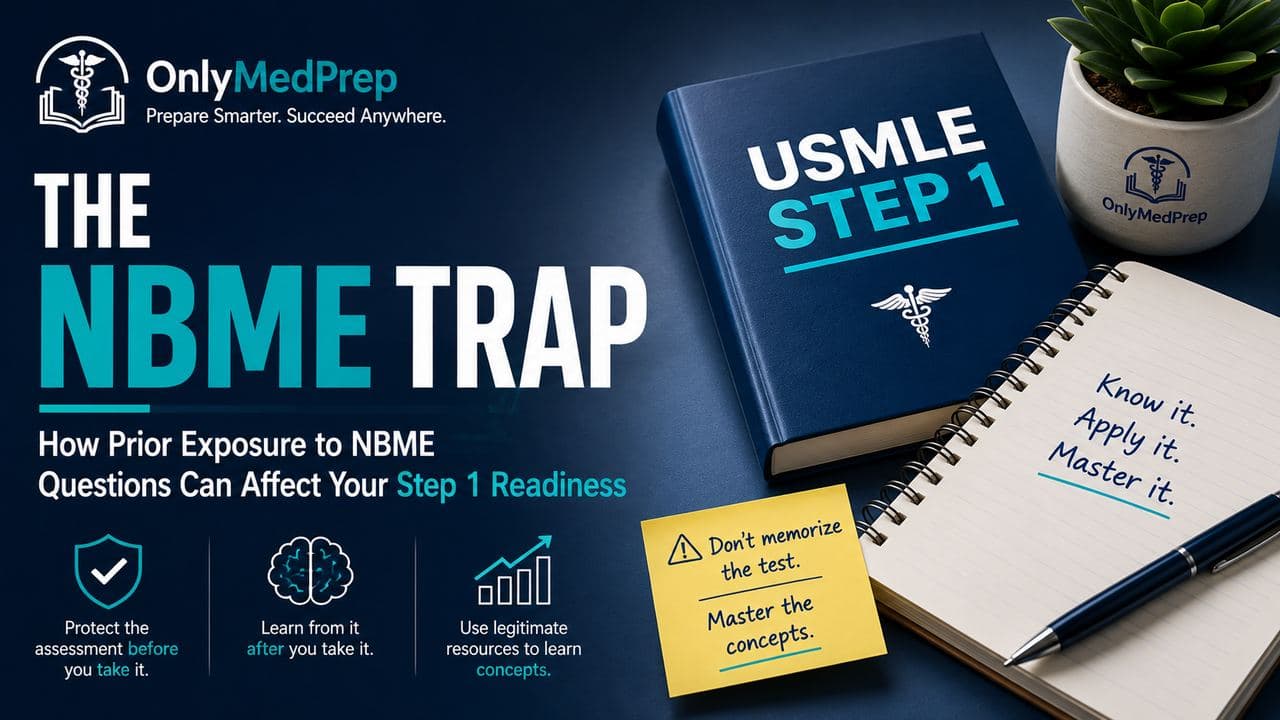
Before you take an NBME self-assessment to gauge your readiness, ask yourself one question:
Have you already studied the questions?
NBME self-assessments—such as the Comprehensive Basic Science Self-Assessment (CBSSA) for Step 1—are designed to help students evaluate their readiness, identify strengths and weaknesses, and track their progress. NBME recommends considering CBSSA results alongside other information when assessing readiness, particularly when the assessment is taken under conditions that resemble the actual Step 1 experience.
The problem is not reviewing an NBME after you take it. Reviewing your performance, reading the explanations, and learning from what you missed are important parts of preparation. The concern is narrower: studying materials that reproduce the specific questions from an assessment before you take it.
This can happen more easily than many students realize. A shared Anki deck, flashcard set, or document built from previously used NBME items may not feel like “studying the test.” It may simply seem like another resource for USMLE preparation. You read the questions, review the explanations, and learn the concepts. Over time, however, the vignettes, answer choices, or explanations can become familiar.
Then you take that NBME, the answers may come more quickly, the score may be strong, and the natural conclusion may be:
“I’m ready.”
The knowledge may well be real. However, prior exposure can make the score harder to interpret as an independent measure of how you will perform on unfamiliar questions. Familiarity with assessment material may contribute to performance in addition to independent problem-solving.
Key Takeaway
Learn the concepts with legitimate study resources. Use the NBME as a readiness checkpoint. Then use what the assessment reveals to guide your next steps.
Learn the Concepts, Don’t Memorize the Items
Learning the material tested by an NBME is exactly what you should be doing. If you are studying endocrine physiology, renal physiology, pathology, pharmacology, or another Step 1 topic that happens to appear on an assessment, there is no reason to avoid learning that material.
The concern is specifically using a resource that reproduces the questions and explanations from an assessment you plan to use as a readiness checkpoint.
Think about your resources according to their purpose. A Qbank is designed for practice—you should expect to see questions, make mistakes, review explanations, and encounter similar concepts repeatedly. Learning resources and spaced-repetition tools are designed to teach and reinforce knowledge.
An NBME self-assessment, when used as a checkpoint, serves another purpose: helping you evaluate where you currently stand.
Prior Exposure Can Vary
In reality, students may encounter some NBME-derived material without realizing it. Community-created decks and shared resources can contain material derived from different assessments, and it may not always be obvious where a particular question originated.
The practical goal is therefore not to pretend that all prior exposure can be eliminated. Instead, manage your exposure whenever possible.
If you plan to use a particular NBME as a readiness checkpoint, consider using an official form that you have not previously studied. Avoid deliberately studying resources that reproduce that assessment’s specific questions before taking it.
If you have already encountered some of the material, that does not mean the assessment is useless. It simply means you should be more cautious about interpreting the resulting score as a completely independent measure of readiness.
A Practical Approach
When possible, use an official form that you have not previously studied as your readiness checkpoint.
Use other legitimate learning resources and your Qbank to learn and practice the underlying concepts.
If you have already reviewed a particular assessment extensively, treat it primarily as a learning tool rather than a clean measurement of readiness.
When interpreting your readiness, consider your overall pattern of performance rather than relying on one score. Look at multiple assessments when available, your Qbank performance, your ability to solve unfamiliar questions, and your performance trend over time.
NBME’s probability-of-passing estimate is an estimate, not a guarantee of future performance. It should therefore be considered as one piece of information rather than the only factor in deciding whether you are ready.
What to Do After the NBME
Once you have taken the assessment, the approach changes.
Now the questions can become valuable learning opportunities.
Review the questions you missed, guessed on, or did not fully understand. Read the explanations and identify the underlying concept that needs additional work.
The goal should not simply be to remember:
“The answer to this question was C.”
Instead, ask:
“What did this question reveal that I don’t understand well enough yet?”
For example, instead of memorizing a particular question about SIADH, you might identify the underlying weakness:
“I don’t understand why SIADH produces this laboratory abnormality.”
That concept can then be reviewed and tested in a different clinical scenario.
This distinction is important because recognizing a familiar question is not the same as understanding the concept well enough to apply it when the presentation changes.
Don’t Let a Practice Score Become the Goal
A strong practice-test score can be encouraging. But the goal of an assessment is not simply to produce the highest possible number.
The more useful question is:
“What does this result tell me about my current ability to solve unfamiliar problems?”
A score obtained after substantial prior exposure to the assessment may still demonstrate knowledge, but it can be harder to interpret than a score obtained without that exposure.
For that reason, students should look at the broader picture of their preparation rather than allowing a single practice score to determine their confidence.
There Is Also an Exam-Integrity Issue
There is also an important issue beyond measurement.
Students should be cautious about resources that reproduce or reconstruct secure examination content. USMLE considers its examination materials confidential and copyrighted and prohibits unauthorized reproduction, reconstruction, dissemination, or obtaining unauthorized access to examination materials.
Using legitimate educational resources to learn the underlying concepts avoids both the measurement problem and potential examination-security concerns.
The Bottom Line
Learn with your learning resources.
Practice with your Qbank.
Use the NBME as a checkpoint.
After the checkpoint, learn from what it reveals about your weaknesses.
If you plan to use a particular NBME to evaluate your readiness, avoid deliberately studying resources that reproduce its specific questions beforehand whenever possible. Protect the assessment so that it can provide the most useful information about where you actually stand.
Then, after you take it, learn from your mistakes and use those results to guide your next steps.
Protect the assessment before you take it. Learn from it after you take it.
The goal is not to memorize the test.
The goal is to know whether you can apply what you know when the clinical scenario is genuinely unfamiliar.